Research
My research develops statistical and computational methods for studying how policy spreads and how public officials communicate, and applies them to state, local, and international politics.
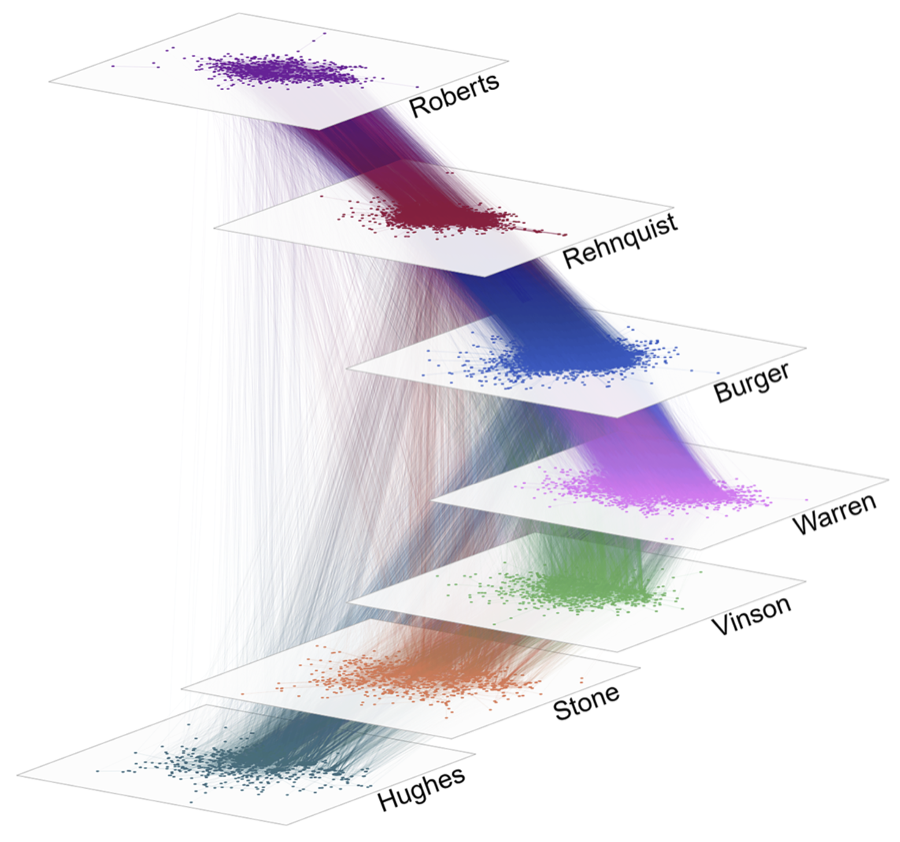
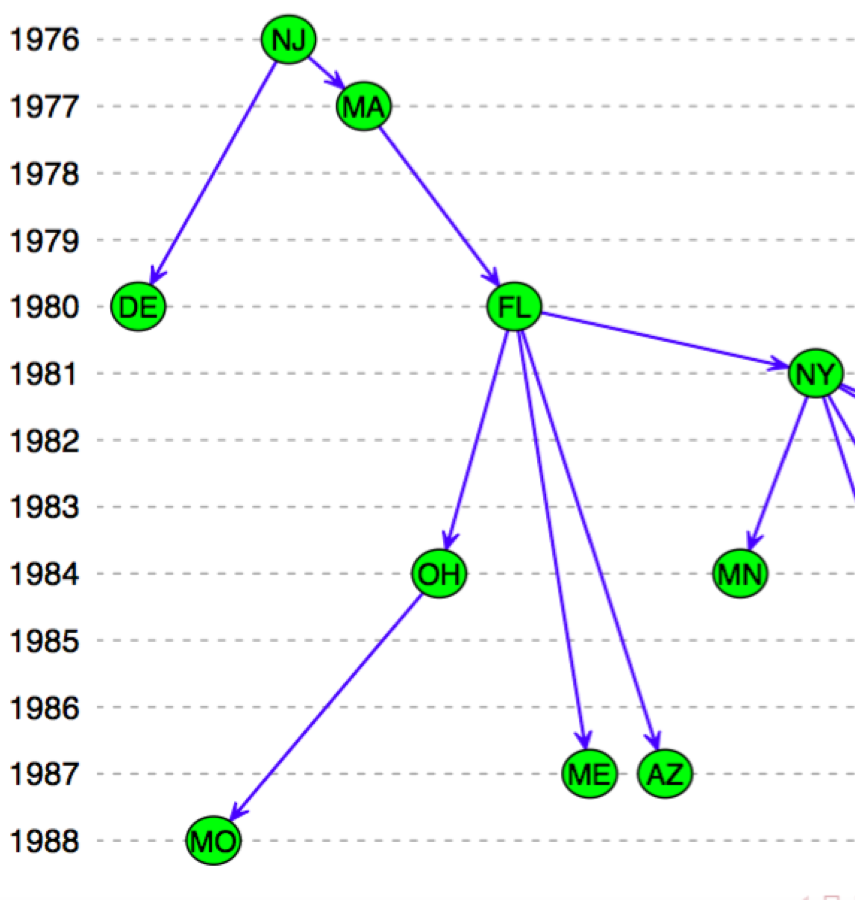
Policy diffusion and networks
How policies spread across states, cities and countries, and the statistical methods (network event history analysis, latent network inference) that recover who learns from whom.
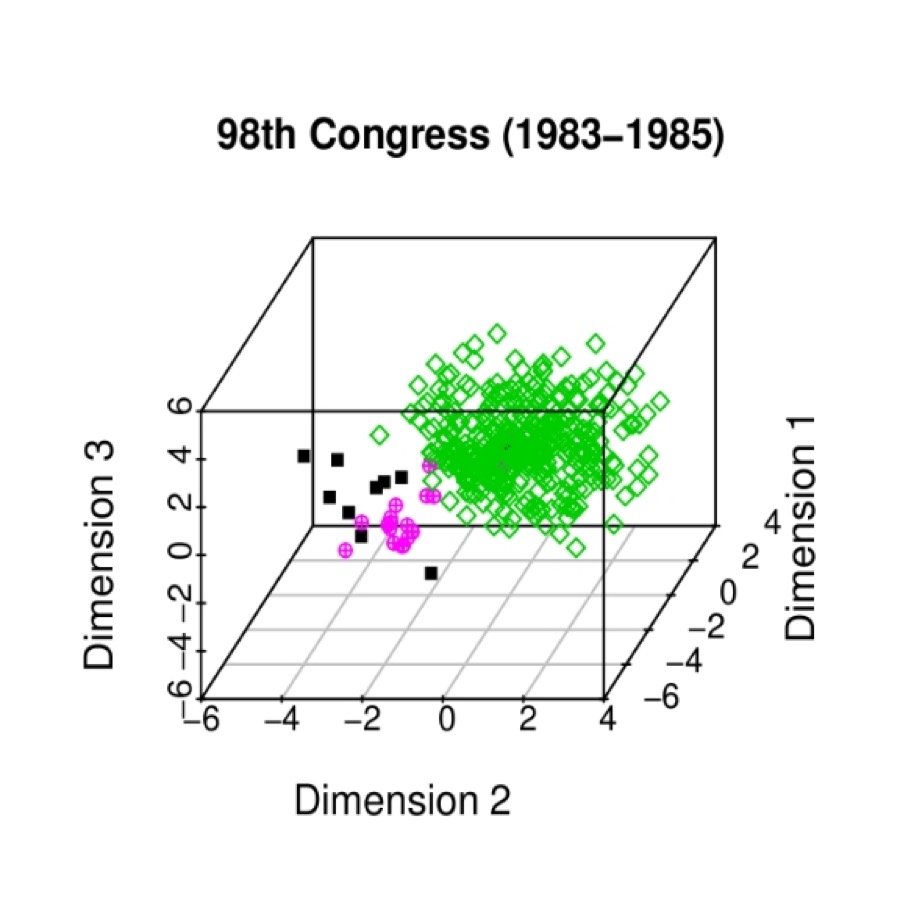
Digital communication and public officials
How elected officials and local governments communicate online, from misinformation and harmful content to how residents engage with official posts.
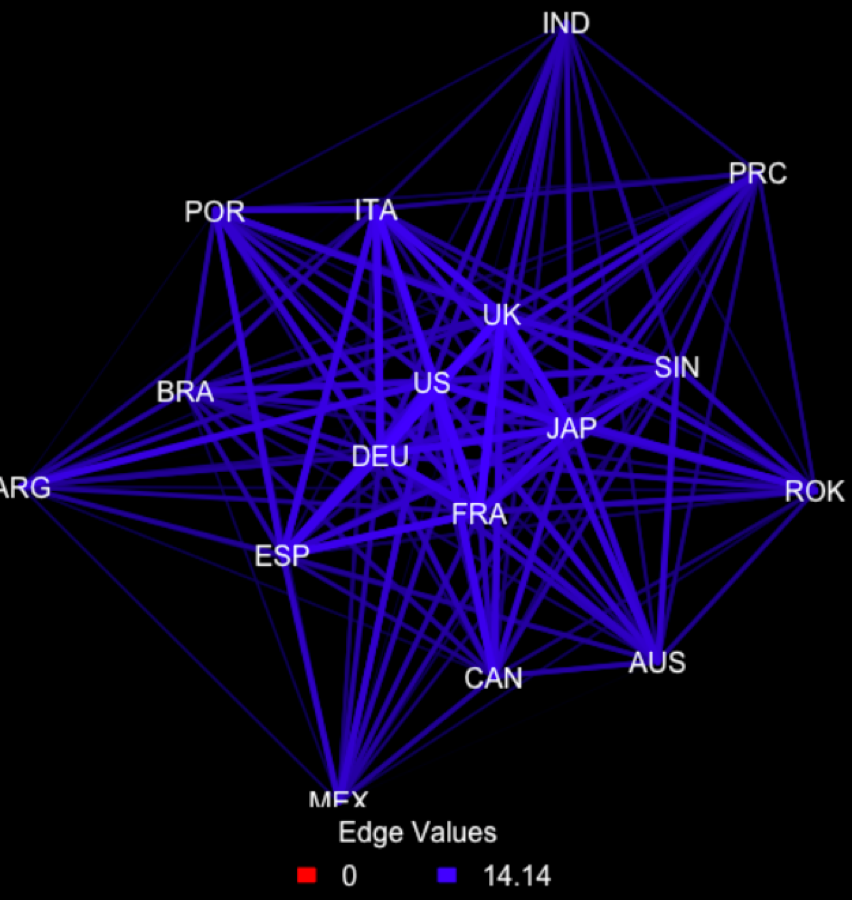
Network analysis and inferential methods
Statistical models for networks, including ERGMs, TERGMs and network-effects regression, with open-source software for applied researchers.
AI and machine learning for social science
Using machine learning and generative AI as research instruments, and measuring how AI is changing government and public communication.
Publications
Book (1)
Journal articles (58)
- palsr: Projected Actor Locations for spatial modeling of dyadic interactions between moving actors
- Elected officials' online anti-vaccination statements respond to online engagement
- The Digitally Accountable Public Representation Database: Online Communication by U.S. Officials
- Elected Officials' Online Sharing of Misinformation: Institutional and Ideological Checks
- Networks of Inclusion: Using Teams and Technology to Create Diverse Social Capital
- Collaborative Diffusion: The Dynamics of Policy Output in COVID-19 Interstate Compacts
- Legislative support for environmental policy innovation: an experimental test for diffusion through a cross-state policy network
- Causal Evidence for Theories of Contagious Civil Unrest
- The National Network of U.S. State Legislators on Twitter
- Official yet questionable: examining misinformation in US state legislators’ tweets
- SPRC19: A Database of State Policy Responses to COVID-19 in the United States
- Contagion, Confounding, and Causality: Confronting the Three C’s of Observational Political Networks Research
- A diffusion network event history estimator
- A double-edged sword: The conditional properties of elite network ties in the financial sector
- Spatial modeling of dyadic geopolitical interactions between moving actors
- Attention to the COVID-19 Pandemic on Twitter: Partisan Differences Among US State Legislators
- Government websites as data: a methodological pipeline with application to the websites of municipalities in the United States
- Generative dynamics of supreme court citations: Analysis with a new statistical network model
- Complex dependence in foreign direct investment: network theory and empirical analysis
- Text as policy: Measuring policy similarity through bill text reuse
- SPID: A New Database for Inferring Public Policy Innovativeness and Diffusion Networks
- The contagion of democracy through international networks
- Migration and political polarization in the US: An analysis of the county-level migration network
- modeLLtest: An R Package for Unbiased Model Comparison using Cross Validation
- Punctuated equilibrium or incrementalism in policymaking: What we can and cannot learn from the distribution of policy changes
- A consistent organizational structure across multiple functional subnetworks of the human brain
- Speaking truth in power: Scientific evidence as motivation for policy activism
- Considering Network Effects in the Design and Analysis of Field Experiments on State Legislatures
- Public Comments' Influence on Science Use in US Rulemaking: The Case of EPA's National Emission Standards
- Weighted Exponential Random graph models: Scope and large network limits
- Discussion of “Inferring social structure from continuous-time interaction data”
- Models, methods and network topology: Experimental design for the study of interference
- Statistical modeling of the default mode brain network reveals a segregated highway structure
- Temporal Exponential Random Graph Models with btergm: Estimation and Bootstrap Confidence Intervals
- What Can We Learn from Predictive Modeling?
- Stochastic Weighted Graphs: Flexible Model Specification and Simulation
- The Seeds of Policy Change: Leveraging Diffusion to Disseminate Policy Innovations
- Transparency by Conformity: A Field Experiment Evaluating Openness in Local Governments
- A critique of dyadic design
- Science Use in Regulatory Impact Analysis: The Effects of Political Attention and Controversy
- Persistent Policy Pathways: Inferring Diffusion Networks in the American States
- Measuring Legislative Collaboration: The Senate Press Events Network
- The Fates of Challengers in US House Elections: The Role of Extended Party Networks in Supporting Candidates and Shaping Electoral Outcomes
- Public Policy's Bibliography: The Use of Research in U.S. Regulatory Impact Analyses
- An Unbiased Model Comparison Test Using Cross-Validation
- Testing for Zero-Inflation in Count Models: Bias Correction for the Vuong Test
- Reciprocity and the Structural Determinants of the International Sanctions Network
- Micro-Level Interpretation of Exponential Random Graph Models with Application to Estuary Networks
- Toward a Network Theory of Alliance Formation
- Standing the Test of Time; The Breadth of Majority Coalitions and the Fate of U.S. Supreme Court Precedents
- Complex Dependencies in the Alliance Network
- Comparing Partial Likelihood and Robust Estimation Methods for the Cox Regression Model
- Statistical Inference for Valued-Edge Networks: The Generalized Exponential Random Graph Model
- Lessons in disguise: Multivariate predictive mistakes in collective choice models
- Statistical Mechanics of Networks: Estimation and Uncertainty
- Inferential Network Analysis with Exponential Random Graph Models
- Linear Models with Outliers: Choosing Between Conditional-Mean and Conditional-Median Methods
- Portfolio Adjustment to Home Equity Accumulation among CRA Borrowers
Peer-reviewed proceedings (13)
- AI Use in U.S. Local Government Communications: Prevalence and Reach on Social Media
- The Study of Short Texts in Digital Politics: Document Aggregation for Topic Modeling
- Silence and Noise: Self-Censorship and Opinion Expression on Social Media
- GenAI vs. Human Fact-Checkers: Accurate Ratings, Flawed Rationales
- Political Elites in the Attention Economy: Visibility Over Civility and Credibility?
- STAND: A Spatio-Temporal Algorithm for Network Diffusion Simulation
- The Effects of an Informational Intervention on Attention to Anti-Vaccination Content on YouTube
- Policy-Relevant Science: The Depth and Breadth of Support Networks
- Collapsing corporate confusion: Leveraging network structures for effective entity resolution in relational corporate data
- Exponential random graph models with big networks: Maximum pseudolikelihood estimation and the parametric bootstrap
- Topic-Partitioned Multinetwork Embeddings
- Forecasting the Locational Dynamics of Transnational Terrorism: A Network Analytic Approach
- Consistent Confidence Intervals for Maximum Pseudolikelihood Estimators
Chapters in edited volumes (3)
Software
palsr
Projected Actor Locations for spatial modeling of dyadic interactions between moving actors (SoftwareX, accepted).
neha
Network event history analysis: models diffusion while accounting for covariates and latent network ties.
modeLLtest
Compare models with cross-validated log-likelihood (CVDM and CVMF tests).
btergm
Temporal exponential random graph models by bootstrapped pseudolikelihood.
GERGM
Estimation and fit diagnostics for generalized exponential random graph models.
NetworkInference
Inferring latent diffusion networks with the netinf algorithm.
Funding
My research has been supported by the National Science Foundation, the Russell Sage Foundation, and the Hewlett Foundation.
- NSF Award Number SES-2446647. “Collaborative Research: Georelational Dynamics in Collective Action,” effective 09/15/2025; $162,395
- NSF Award Number SES-2449569. “Collaborative Research: Belief Systems Governing Climate Adaptation Behaviors: Inference, Analysis, and Intervention,” effective 06/01/2025; $148,477
- NSF Award Number SES-2318460. “Collaborative Research: HNDS-I: Digitally Accountable Public Representation,” effective 09/01/2023; $649,380. PI with Sarah Rajtmajer and Kevin Munger, Co-PIs
- NSF Award Number SES- 2148215. “Collaborative Research: Patterns, Context, and Secondary Impacts of State Policy Responses to the Pandemic,” effective 07/01/2022; $366,181
- NSF Award Number SES- 2028675. “RAPID: Collaborative Research: The Diffusion of State Policy Responses to the 2019 Novel Coronavirus,” effective 05/15/2020; $16,417